Wednesday, February 27, 2008

Victorian Architecture

[1]
(The historic Littlefield House has seen many generations and is still standing in fabulous condition.)


On a beautiful day in the city of Austin, hundreds of students, faculty, and Austinites stroll past the Littlefield House, a historic building on the corner of 24th and Whitis. Previously open to the public for tours, the Littlefield House has since closed its doors, opening only for special occasions and meetings. Now, walking around campus and even the surrounding neighborhoods, it is very unlikely one would find a house similar to this one; “the Littlefield Home is the only remaining example of the grand Victorian mansions that were once numerous in the University neighborhood” (Bump 346).

Having little gothic architecture in the area, it can be difficult for many to appreciate the style and familiarize themselves with it. Ruskin does an excellent job of depicting his appreciation of gothic architecture or the basic, boring architecture of today: “we must no more expect to derive either pleasure or profit from an architecture whose ornaments are of one pattern, and whose pillars are of one proportion, than we should out of a universe in which the clouds are all of one shape and the trees all of one size” (Ruskin 535)

Gothic architecture, more than most styles, is an “expression of energy in the framework of the ornament itself” (Ruskin 535). The designers of the Littlefield House and other gothic style buildings pay great attention to detail and adorn the building with minute decors. The outside of the building is decorated from top to bottom.

Made of red-brown brick and white marble dust along with “polished blue granite columns [that] flank the entrance of both levels of the two-story veranda,” (Bump 346), the Littlefield house is quite a sight to see. Beautiful iron railings surround the top and bottom porch with designs worked into them. [2] (side picture of the beautiful and impressive Littlefield House) The house is shaped with many curves and various angles to the building. The roof is one of the most striking features of the house from the outside. With its steeple and pointed rooftop, as well as windows and delicate designs, the rooftop finished off the Victorian look and adds a sort of elegance to the house.

From the outside, the Littlefield House is most impressive. However, upon entering the house, or at least seeing pictures of the inside of the house), one is once again taken aback but its utmost beauty and intricate detailed designs. [3] The sitting room, (in picture) although the green carpet and wall coloring is not the extremely appealing, is another example of great attention to detail. Look at the fireplace; from the tile that surrounds it to the gothic structures that sit on the mantle, every inch of the structure has been considered and designed carefully.

I identify with Ruskin’s view that “no pleasure is taken anywhere in modern buildings, and we find all men of true feeling delighting to escape out of modern cities into natural scenery” (Ruskin 535). Now, I feel this view is a little exaggerated, but I do at times wish to live the new, modern world we live in for a retreat to the past, to the classic times. Over Christmas break, I visited New Orleans, a place I lived for 9 years, and rediscovered the city.
( This is a home in the French Quarter with typical gothic architecture and iron railings.) I was fascinated by the architecture found there, between the elaborate and highly expensive lofts in the French Quarter, one home to Brad Pitt and Angelina Jolie, to the more moderate yet still fantastically designed homes in the more impoverished areas. Being an area that was greatly influenced by the French, New Orleans is known and will continue to be known for its great architecture.

I would say that Victorian architecture is one of the most beautiful and noteworthy styles around. I am grateful that the University of Texas has taken it upon itself to preserve the Littlefield House and this remnant of Victorian architecture still here on campus.

[1]http://www.cwrl.utexas.edu/~bump/images/arch/lh/

[2]http://www.cwrl.utexas.edu/~bump/images/arch/lh/

[3]http://www.cwrl.utexas.edu/~bump/images/arch/lh/

Monday, February 18, 2008

If You Are Pointing Fingers, Point Them At the Video Games


(Above is a picture of me with my parents, both very strict yet still connected with me and my siblings.)


“The sympathetic imagination is the ability of a person to penetrate the barrier which space puts between him and his object, and by actually entering into the object, so to speak, to secure a momentary but complete identification with it” (WJ Bate 131)

The “object” I am aiming to identify with is the idea that liberals are not only the cause of 9/11, but are bringing down society as a whole and that their ideals and morals need to change.

Rather than taking the approach that many took, arguing from the perspective of someone like Osama Bin Laden, I am going to argue from the perspective of parents. In general, parents attempt shelter their children from the negative aspects of the life. Often times, children do not understand the goal of this and end up rebelling, however, having grown up in an extremely strict household, I have come to appreciate the sheltering I received.

Childhood is one of the most impressionable times of someone’s life. Children grow up to run the world, to make decisions; they are the future. It is for this reason that we must censor everything involving sex and violence.

What is the value of putting negative images and ideas into the environment for youth and even adults to absorb, eventually affecting their behavior, personality, and views?

On April 20, 1999, two shooters by the names of Eric Harris and Dylan Klebold entered Columbine High School armed with both bombs and guns with the intention of blowing up the cafeteria and the library. (This is a picture from a security camera of the boys during their shooting spree.) When the bombs placed in the cafeteria failed to fully detonate, the boys, anxious to begin their killing spree, entered the school area and immediately killed Rachel Joy Scott and injured a friend a hers sitting nearby. The shootings continued for approximately 50 minutes. The end result was shocking, terrifying and heartbreaking; 12 students and 1 teacher were killed and 24 students were injured. Harris and Klebold both committed suicide in the library after committing this tremendous crime and destroying the lives of many innocent people.

Post-shooting, the boys’ lives were investigated and it was discovered that violence was not a stranger to them. The boys spent a great deal of time playing violent video games that simulated shooting and killing people,

such as Doom and Wolfstein 3D, as well as other acts of violence. The boys had also recorded videos of themselves describing what they wanted to do and voicing the hate they felt for the world and many of their classmates.

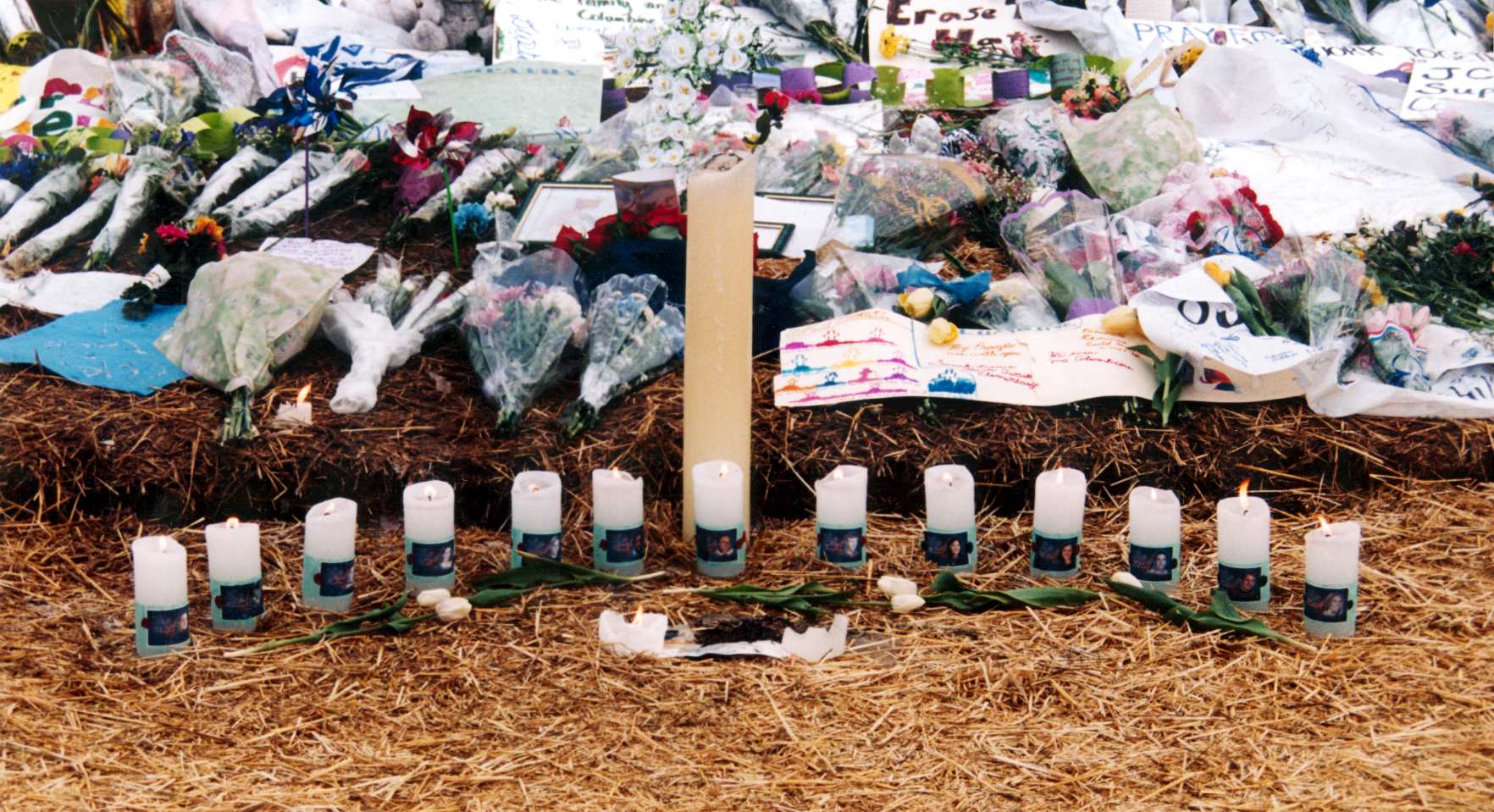
Now, I do not fully blame violent video games for the mental disturbances that these boys must have suffered from, but I do believe that the violent games largely contributed to their ability to recreate violent scenes and dream up their killing scenes. Had Harris and Klebold’s parents monitored their activities had viewed video games more conservatively, it is very likely that those 13 people would still be alive today rather than being killed in their school, a place that is supposed to be a safe haven. (This is a memorial for the 13 killed in the Columbine shootings.)

If we were to rid the nation and even the world of these games and ideas, fighting and violence would be far less prevalent in the minds of young boys and girls and the excitement that these games can create would disappear. There is no reason for us to encourage children, or anyone for that matter, to think about inappropriate sexual or violent acts that do nothing positive for society. We should eliminate these as much as we can before they cause more damage to our world.

EXTRAVERT!! THATS ME! :)


(Johnny Depp, pictured above, also has the "Teacher" personality.)


According to the Carl-Jung Personality test, I am “very expressed extravert, moderately expressed intuitive personality, slightly expressed feeling personality, slightly expressed judging personality” [1].

One of my first experiences with personality typing was “True Colors,” (shown to the left) a test with questions similar to those on the Carl-Jung test, however rather than answering “yes” or “no,” you are given four different options on a topic and you rank them in terms of which you identify most with. After ranking all of the options, you would add up the scores for each column (each column identified with a certain color) and the highest scoring color would be your personality type. The four personality types/colors are orange, gold, green and blue.

An orange personality type is very outgoing, adventurous, and strives to have fun in every situation. A gold personality type is extremely organized, goal orientated and likes to have a structured life. A green personality type is the intellectual, analytical thinker who strives on finding out “why?”. And finally, the blue personality type is the caring, compassionate, “let’s all be friends” personality. Now these are all very basic, shallow descriptions of the personalities, however, they provide much more information, such as what aggravates each personality type, how they work best, what they need to be successful, etc.

When I took this test, I was primarily orange, with green, gold and blue following in that order. I found this test to be quite accurate and fit me very well. I identified closely with the orange personality type and felt the descriptions were surprisingly accurate.

When reading the description of my personality type, I found that I could identify with some but not all of the personality traits, as expected. The test classified me as a “Teacher,” which I wasn’t sure fit when I first read it. I view the teacher figure more as a sympathetic, caring person, more introverted and soft-spoken. The normal teacher figures in our lives are extremely good at relating to us, coming down to our level to ensure that we understand and see if we need any assistance. I don’t view myself as someone who acts this way. I find myself to sometimes by more “my way or the highway” orientated rather than “let me help you out” oriented. But my view of the teacher is not the same view of the teacher that the personality test presents. Although they begin by saying that the ENFJ (the category I fall into) people are “benevolent 'pedagogues' of humanity,” they continue on to describe that “ENFJs have tremendous power to manipulate others with their phenomenal interpersonal skills and unique salesmanship. But it's usually not meant as manipulation -- ENFJs generally believe in their dreams, and see themselves as helpers and enablers, which they usually are.” When I first read this, especially the line about wanting to be a helping, my thoughts immediately went to what I described as my passion in class: helping children, especially those who have come upon difficult times. Perhaps this personality test is far more accurate than I had imagined.

I feel that I identify most with the extraverts out of the four different categories I was put into, which it what the test indicates as well. Extraverts “talk in class,” which all of us know I do very well, “have short attention span[s],” can get bored during “just lecture” (392). These all fit me exactly. One of the reasons I want to be a doctor is because many other jobs would become too monotonous for me. A doctor is constantly dealing with new situations and difficulties, a challenge I will thoroughly enjoy. As for getting bored during lectures, this is the story of my life. In high school, I fell asleep during numerous government classes and even now in college, I have a very difficult time staying awake in lectures. (This is about what I look like during some of my classes.)

As for writing styles, it fits perfectly!! I didn’t read an extravert’s approach to writing until right before I started this paragraph. According to this personality analysis, extraverts “leap into writing; outline later” and “write from lived experience,” (397) which is exactly how I write and even how I wrote this paper! I also “become blocked as a result of having generated shallow ideas or too many ideas” (398). Sometimes I find that I jump around in my paper or fail to develop any points very thoroughly; rather, I develop them a whole bunch of them on a shallow level. This is something that I really need to work on in terms of my writing.

I really enjoyed this personality type test and am going to share it with my friends. As I wrote this paper, Kristin, my best friend, became interested in what I was saying and decided she is going to take the test tonight!! It is an interesting way to get a little more introspective and really discover strengths and weaknesses.

[1] http://keirsey.com/handler.aspx?s=keirsey&f=fourtemps&tab=3&c=teacher

Monday, February 11, 2008

To Censor or Not To Censor


(In the spirit of Valentine's Day, I thought this was rather appropriate. It is a film that focuses on both violence and sexuality on a day of love and compassion.)

“There is a widespread agreement in America that the family is in crisis” (D’Souza 153).

That is quite a statement to make. However I do agree with it to some extent. And I partially blame the media and pop culture. Still, we cannot simply erase the problems by getting rid of the sources altogether. The process is slightly more complicated than that.

After reading many others’ ideas on censorship of sexuality and violence in the media, it seems that most are at a consensus that there should be censorship to some extent, despite the American ideal of freedom. And I too agree with that. However, we must respite the wide range of opinions and mindsets that are found in the United States.

I am not a big television viewer, but I do watch it when I work out. Just the other day, while on the elliptical, I was flipping from channel to channel trying to find something entertaining to watch. And sure enough, “Road Trip” was playing on one of the free movie channels. Having seen the movie previously, I was shocked to see it being played on a station that anyone, including children could see. I continued to watch and was pleasantly surprised when I saw that they bleeped out foul language and eliminated crude sexual parts. Of course, it isn’t impossible to figure out what that what the person’s mouth says isn’t what you hear, but the problem of inappropriateness was mainly taken care of. (Pictured is the cover of the unrated version available of Road Trip. Luckily, this was not the version shown on television.)

I read a book written by Jenna Jameson (pictured to the left), playmate, porn star, and owner of a strip club in Scottsdale, Arizona. In this book, she chronicles her life and upbringing, as well as a detailed depiction of the sexual world and the craziness that comes along with it. In one part of the book, she describes the “baby steps” she took and someone could take to become a porn star, including “teenager wants to be a model….he thinks she’s special…dating a tattoo artist and biker…becomes a stripper…starts modeling nude [because] it’s just like real modeling, except with stripping added in…starts acting in soft-core all-female adult movies”[1]. Wow. A full out description of how to become a porn star. When I read this, I though to myself, “why would she ever include this in her book? Who REALLY wants to be a porn star?” And then I realized that many people do. Of course, I have absolutely no interest in pursuing a career of that kind, however some, in fact many, do. Just because I find the idea to be repulsive and degrading does not mean that everyone does. This leads me to my conclusion that although I don’t agree with some of the sexual exposure of today’s society, and violence exposure on the same token, I don’t believe that we can or should eliminate it. As Wiley said, “my distaste is my preference.”

D’Souza states that “conservatives must pressure liberal Democrats to decide how they want to be perceived by the American people” (D’Souza 292). I believe that the liberals, who are allowing and promoting sexuality and violence to some extent, already understand how the world perceives them. They know that many, such as the Islamic Muslims, disagree with their views and freedom of expression. And they support censorship to some extent. This is how America should be. Those who want to find the vulgar sections of life can and those who want nothing to do with it, can avoid it. That is why we have more than one channel on television, millions of different kinds of books, movies and music, and different political parties. We can all choose what we want and stand by it.

[1] Jenna Jameson with Neil Strauss, How to...Make Love Like a Porn Star: A Cautionary Tale (New York: HarperCollins Publishers, Inc., 2004), 126.
[2]

Wednesday, February 6, 2008

Differences that Lead to Disaster


What a claim to make: “The cultural left in this country is responsible for causing 9/11” (D’Souza 1). I was shocked, and slightly offended when I read this statement, partially due to my patriotism and dislike of people picking at various aspects of American culture, but partially because I find that I fall under the “cultural left” D’Souza speaks of. (This is the World Trade Center of September 11th after being crashed into by airplanes.) Although I am not extremely political, I feel that I would identify more with the liberal Democrats than the conservative Republicans.

D’Souza discusses a conversation he heard on TV between an interviewer and a sheikh. The sheikh, after being questioned about his distaste for America despite the relatives he has living in America, make the outrageous claim that “’What America appeals to is everything that is low and disgusting in human nature’” (D’Souza 16). Wow. How is it possible for there to be such a great cultural divide that someone could think so poorly of America, the country that has been built up from the ground, started from nothing, and continued to flourish?

Traditions. Tradition is defined by the Oxford American Dictionary (1) as the transmission of customs or beliefs from generation to generation, or the fact of being passed on in this way. It is a powerful world and extremely important in many cultures, including Islamic and American. The differences in our traditions seem to be a majority of the cause for the wars we face today. America’s tradition, if you will, of prosperity and rapid progression and a continual bettering of our society clashes with the Islamic tradition of living with what is necessary, not over indulging, a slower, steadier progression. Islamic people do not hate America for the sole reason that we are more indulgent at times than they are; Islamic people hate America because it is different than what we are used to.

Yes, we tend to overindulge. (Cartoon demonstrates the overindulgence that occurs at Christmas time and on a regular basis.) Yes, we idolize those who have more money than some would ever dream of. Yes, we spend countless hours reading and watching programs about celebrity drama, things no one really should care too much about. But that is not all that makes up America. We are a county of freedom, of determination, of love and passion, and of power. We are ever changing and will continue to advance in the face of opposition.

D’Souza raises the question, “Does Western culture promote immoral values that corrupt people, especially the young?” (D’Souza 119). To this I would answer that America is like a sampler dish. It has a little bit of everything. Some of it is good. Some of it is not. Some people choose to eat the stuff that isn’t so tasty while others remain steadfast for the delicious treats. Each person must make a choice. (Picture is an Islamic city.) America is the same. Everyone must choose what path to follow, and the beauty of it all is the choice itself.

(1)The Oxford American Dictionary on my MacBook

Monday, February 4, 2008

Questioning the Sacredness of Marriage


(This traditional view of a family is rarely the case anymore. These days, you would likely see a step mom, rebellious half children and other abnormalities.)


Out of the whole Qu’ran, I found the chapter “On Marriage and Family Life” to be the most interesting. Today, these seems to be two of the most talked about topics. From shows such as “Newlyweds” which focuses on the beginning of a lifetime together to shows
such as “Divorce Court” that aims to highlight problems in today’s society, we tend to spend a great deal of time and energy on the idea of marriage.

In America, for the most part, we stand by the idea on monogamy, for two people to be united and for a man to have one wife and a woman to have one husband. They are to “love and to cherish till death do [they] part,” as said in the standard wedding vows.

It is curious to me, however, how the fantasy of one partner for life seems to be fading quickly. In the olden days, marriages would be arranged and once the ceremony was complete, the two would be together forever…the end. These days, it seems to be a lot more complicated and the sacredness of marriage is diminishing. Muhammad is told to “Marry women who please you—two, three, or four—but if you fear you won’t be equitable, then only one, or a legitimate bondmaid of yours. That way it is easier for you not to go wrong” (As stated by Muhammad, 195). In the Qur’an, the idea of polygamy is accepted and even encouraged. When I read this, I tried to fathom how America would be if we had the same belief. I just couldn’t imagine it…we wouldn’t do that. We are traditional, in our sense of the word. Right? And then I realized something. The real difference between the cultures in terms of marriage is that they accept from the beginning that they will likely have multiple spouses while we marry with the ignorant idea that there is no possible way we will ever get divorced and remarried.

I am extremely lucky. (This is a photo of me and my family.) My parents have been married for over 25 years and are happy as can be. Divorce is nowhere in sight for the two of them. However for nearly half of American families, divorce is a brutal reality that has affected them a great deal, either in their own homes or in the homes of close family and friends.

My best friend, Craig, has parents who divorced a year ago. I met the family when they were together and happy but soon after, I heard the news that they would be separating. Talking to Craig about the divorce and the aftermath was and still is heartbreaking. He speaks poorly of the way his mother dealt with things and has a great deal of frustration towards his father for the role he is now trying to play in Craig’s life. (This is me and Craig when he came to visit me here at UT...i don't know how to rotate the picture in here! Sorry! )Less than a year after getting the divorce, Craig’s mother began dating a man who she is currently still with. Talk about a difficult situation. Craig went from seeing his parents together to seeing his mother gallivanting around with a stranger. How is it she was so quickly able to leave behind the matrimony she entered into years before and begin a new adventure with a complete stranger…all the while having her kids watch her. It was shocking, to say the least.

In the world of Hollywood, it is very rare that couples will stay together and loyal for any length of time. They tend to do things like run off to Vegas and get married on a whim Britney Spears), cheat on their spouse with another celebrity (Ryan Phillipe) or fall in love with a co-star and leave their current relationship (Brad Pitt). (This is a photo of Britney Spears with the man she married in Las Vegas.) ( In every one of these situations, marriage is taken for granted and no great care is given to the fact that is meant to withstand the test of time.

This leads me to wondering whether or not we should accept that marriage, in many cases, will not last forever, and therefore live our lives accordingly, always meeting new people and keeping our options open. I cannot, however, accept this idea of marriage and love. I prefer to live in the fantasy that marriages will last and we can all make it work.

I had an objection to the message Muhammad was told that if there are problems in a marriage, “if the two wish to reconcile, God will reconcile them” (as stated by Muhammad 201). These, I believe, is another example of an excessive reliance of God and lack of personal responsibility. God will reconcile them? No. They will reconcile themselves. And if they do not, it is entirely their fault. I feel that people need to fix problems themselves and stop using God as a crutch. Use him as part of the fixing if one chooses, however to rely entirely on God is, to me, a sign of weakness.