
(We cannot allow patient care to become impersonal as many things have.)
It seems that we have talked a lot about the need for compassion in medicine these days. Some claim that the “role as caregivers is to help relieve suffering in whatever way it arises, whether physical or mental” (Rinpoche 171). But is this really the case? How much do we and should we really expect from doctors when it comes to emotional support? Is it really a doctor’s responsibility to be our support system and encourager or simply a source of knowledge and expertise? Where do we draw the line between a doctor’s role as a professional and their role as a “counselor”? These are all questions that have arisen in my mind since beginning the discussion of compassion in medicine.
In my last entry about compassion in medicine, I discussed the role my skin doctor played when diagnosing me with psoriasis. Lacking emotion, I felt disconnected and uncared for. I switched doctors and found a doctor I was satisfied with. I felt at the time, and still feel, that this was a wise and fair decision. I had no loyalty to the doctor with an attitude. In this case, the line was clear as to how I was treated as opposed to how I should have been treated. In “The Lonely Patient,” the author, Michael Stein
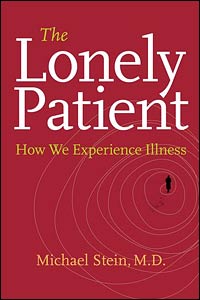 (great book!!) discusses the dilemma he faced when asked to visit one of his patients at home. It was not because it did not care about the patient. In fact, it was quite the opposite. Stein cared so much for his patient that he felt he would be intruding on his space. This brought up the idea that perhaps it isn’t a lack of compassion, but merely the lack of knowing where to draw that line.
This day and age, a person, no matter what profession, must be careful of how far they go with interacting with others. A teacher who reaches for a student can be fired for harassment. A boss who innocently comments on the appearance of an employee can be fired for inappropriate relations with a worker.
 (Is this appropriate?) Basically, anything one does can be misconstrued and held against them. It is an extremely unfortunate situation that this world has gotten into, and it is has spread into the medical field. Many doctors “believe that medical work demands some sort of distance, or at least the appearance of it” [1] and refuse to hug their patients. Why? Hugging is harmless—right??
 If another doctor would to suggest a change in behavior or an increase in caring, they may receive an extremely negative reaction from the other. Often times, “others in positions of responsibility may have the attitude of not wanting to listen to others, confident that their own opinion is best” (Rinpoche 107). If one grows up with the idea that doctors are their simply for their knowledge, changing this mentality would be difficult to nearly impossible.
How can we develop future doctors with the idea that compassion and caring is necessary in the medical field? I believe it begins in the education system, an area that we can change.
 (We must introduce the idea of caring to the youth.) We cannot change the way future doctors are raised in terms of how their parents present ideas to them. We can, however, insert more compassion and courses about compassion into the education system. Perhaps along with organic chemistry and genetics, pre-med students should be required to take a “Compassion and Medicine” course that introduces these ideas to them. This may allow for a more caring and concerned generation of doctors.
[1] Michael Stein, The Lonely Patient (New York: Harpercollins Publishers, 2007) 171

No comments:
Post a Comment